Taiwanese sailor
Life of PiThe Taiwanese sailor is one of four survivors in Pi Patel’s human account of the Tsimtsum’s sinking. Young and unable to speak English, he arrives in the Lifeboat with a severely broken leg; his injury first draws care from Pi Patel and Pi’s mother, then becomes the opening through which the Cook’s violence enters their shared ordeal.
Identity and Arrival
The sailor is in his early twenties, older than Pi Patel, and is described as handsome, with a broad face, flattened nose, narrow pleated eyes, no facial hair, and a clear complexion. Pi Patel thinks his features resemble those of a Chinese emperor. This carefully observed appearance gives the sailor an individuality that the violence to come will make painfully consequential: he is not an abstraction, but a young stranger whose face and suffering remain visible to those around him. He speaks only Chinese, and the others cannot understand even basic words from him. Pi Patel imagines how lonely this must make him. When the sailor weeps, Pi’s mother cradles his head in her lap while Pi holds his hand. Their gestures cannot remove the language barrier or relieve his pain, but they establish a moment of human tenderness around someone whose needs they can only partly understand.
Injury and the Attempt to Save Him
The sailor’s right thigh is badly broken from his jump from the ship, with bone protruding through the flesh. Pi Patel and Pi’s mother set the leg as best they can, give him food and water, and drain the wound’s pus each day, but the injury worsens: his foot turns black and swells. Their efforts establish the limits of care in the lifeboat. They can tend the wound, but they cannot halt its infection or bridge the distance created by their inability to speak with him.
The Cook proposes amputation, arguing that the spreading blackness will kill the sailor unless the leg is removed. He says that, with the break so high in the thigh, the operation will require cutting through flesh and applying a tourniquet; surprise, not anaesthetic, will have to suffice. Pi Patel and his mother restrain the sailor while the Cook sits on his sound leg and cuts. When they release him, the sailor sits up screaming and looks toward the severed limb as if imploring it to return. The Cook folds skin over the exposed bone, binds the stump with cloth, and ties a rope above the wound to check the bleeding. They lay the sailor on life jackets, keep him warm, and watch him moan through the night, his breathing uneven and his consciousness broken by delirium.
At dawn he is still alive, though he drifts in and out of consciousness. His mother gives him water; Pi Patel sees the amputated leg, now thinner and leaking fluid, and picks it up with a life jacket used as a glove. The scene makes the sailor’s survival precarious and bodily: the limb removed in an effort to preserve his life becomes a discarded, deteriorating object in the crowded boat. The operation does not restore him, and the hope attached to it gives way to the consequences of the wound and the Cook’s exploitation of the dead.
Death and the Animal Correspondence
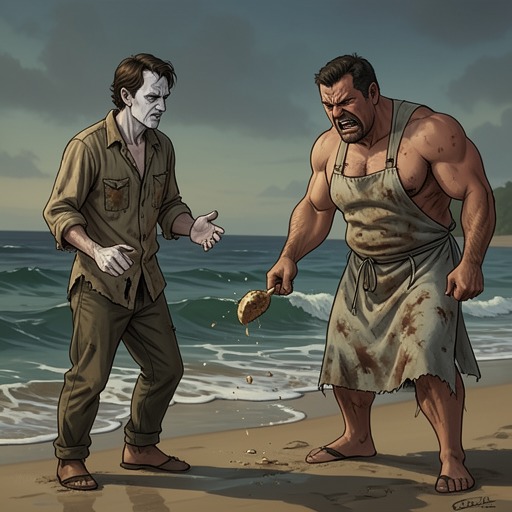
Two weeks into the ordeal, the sailor dies quietly. The Cook immediately turns his body into bait and food. The amputated leg proves useless on the hook: its decayed flesh dissolves in the water. The Cook then cuts up the rest of the body, including the skin and intestines, and even prepares the genitals. Pi Patel and his mother recoil in pain and horror. His mother protests the desecration, but the Cook responds with vulgarity; when she begs him to cover the sailor’s face, he scalps him and pulls the face away before their eyes. The butchered remains are thrown overboard, while strips of flesh and organs are left to dry in the sun around the lifeboat. The sailor’s body, first the focus of helpless care, has become the material of the Cook’s survival—and a scene of moral violence that Pi’s later account cannot leave behind.
In the investigators’ comparison of Pi’s human account with his animal story, the sailor corresponds to the zebra. Both break a leg in the fall from the ship, and in each account the injured leg is cut off or bitten away. The correspondences extend beyond the injury: the Cook is identified with the hyena, while the sailor’s mother corresponds to the orangutan. This mapping recasts the sailor’s suffering as part of the animal narrative’s pattern of attack and loss; it does not erase the human account’s particular details, including his isolation, the attempts to treat him, and the violence done to his body after death.
Voice and Retrospective Recognition
The Taiwanese sailor never gets to recount his own experience: he speaks only Chinese, while the account of his suffering reaches the reader through Pi Patel’s memory and the investigators’ later comparison of Pi’s two versions. His weeping, screams, and injured body become the signs through which others interpret what he cannot explain to them. During the interview, Tomohiro Okamoto draws attention to the parallel between the sailor’s broken leg and the zebra’s, and between the Cook’s amputation of the sailor and the hyena’s attack on the zebra. The recognition gives the sailor a second narrative presence—as the human counterpart through whom the animal story’s violence can be read—without making the two accounts interchangeable. The correspondence clarifies the structure of Pi’s telling, but the sailor’s specific experience remains visible in the details the analogy cannot replace: the language barrier, the attempted care, and the helplessness of those who watched him suffer.